Building Confidence and Self-Esteem in Online Learners
Key Takeaways
- Traditional school environments can undermine confidence in children through public comparison, peer pressure, and fixed-pace learning — this is not a failure of the child
- Online schooling removes many of those confidence barriers, creating space for genuine engagement and academic growth to emerge
- A flexible, self-paced curriculum transforms the learning experience for children who have previously felt left behind or judged
- Small wins and visible milestones are powerful self-esteem builders, particularly for children who have internalised negative narratives about their abilities
- Parents play a significant role: specific praise, consistent routines, and modelling resilience all directly support a child's confidence in the home learning environment
- Social confidence does not require a traditional classroom — for many shy or previously anxious children, it flourishes more naturally outside one
- Many children discover who they truly are as learners once the pressure is removed. That discovery is worth everything
Confidence for online learners is one of the most common concerns parents raise when they are thinking about online schooling, and it tends to come from two very different directions. Some parents worry whether their child will have the self-assurance to learn independently at home. Others are thinking about a child who has struggled emotionally or socially at school, and quietly hoping that a different environment might finally let them breathe.
This article explores how building confidence in children in online school actually works. It unpacks what the research and experience of online learning tells us about self-esteem in homeschool, and what you as a parent can do to actively support your child's growth at home.
Why Traditional School Can Undermine Confidence for Some Children
Traditional schooling works well for many children. But for others, the conventional classroom environment creates conditions that quietly erode confidence over time.
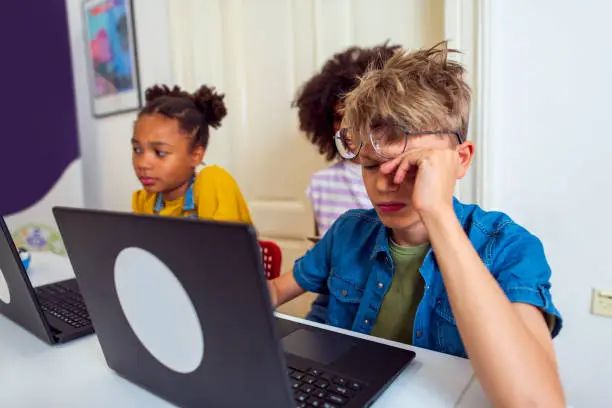
Public comparison is one of the most significant factors. When a child answers a question incorrectly in front of peers, is visibly slower than the class or receives a grade that places them at the bottom of a ranking, the damage to self-perception can be lasting. Add peer hierarchies, social pressure, competitive grading and large class sizes where individual attention is limited, and it becomes clear why children who struggle at school often internalise a story about themselves as learners that simply is not true.
This is not a criticism of traditional schooling overall. It is an acknowledgement that it doesn’t suit every child. For shy children, anxious learners and those who have been bullied or overlooked, a different environment is not a last resort. It is a genuine and legitimate alternative.
How Online Schooling Builds Confidence
When the social pressures of a traditional classroom are removed, something often happens that parents don’t quite expect: their child relaxes into learning. The anxiety that was consuming energy previously spent on self-consciousness and social navigation gets redirected toward genuine curiosity and engagement.
Online school for anxious or sensitive children creates conditions in which this shift can happen naturally, through a private learning environment, freedom from public comparison, and personalised feedback that focuses on the individual child's progress rather than their standing relative to peers. For a detailed look at how this connects to broader emotional development, supporting mental health in online homeschooling is worth reading alongside this article.
Learning at Their Own Pace, on Their Own Terms
One of the most common sources of academic anxiety in children is the pressure of keeping up with the class. When a child doesn’t grasp a concept at the pace the group is moving, they rarely get the time they need to revisit it. Then, the gap widens and so does the belief that they are simply not capable.
A self-paced curriculum removes that pressure entirely. Children can revisit concepts without embarrassment, attempt work without fear of judgement and progress when they are genuinely ready. For children who have been told, directly or indirectly, that they are behind, this experience can be quietly transformative. Their relationship with learning shifts from stressful to empowering. That shift is the foundation on which real confidence is built.
The Power of Small Wins and Visible Progress
Structured online programmes break learning into achievable milestones. This gives children frequent and concrete evidence of their own progress. For a child who has spent years internalising a narrative of being bad at school, these small wins are not trivial. They are the building blocks of a different self-perception.
This connects directly to the concept of growth mindset in education: the understanding that ability is not fixed, that effort drives growth, and that mistakes are part of the learning process rather than evidence of failure. Online learning, by its nature, supports this mindset. Children see their own progress tracked and reflected back to them regularly.
What Parents Can Do to Support Confidence at Home
Can homeschooling improve a child's self-esteem? Yes, but parental involvement significantly shapes how quickly and how deeply that improvement takes root. Practical strategies:
- Celebrate effort, not just outcomes. Specific praise ('I noticed how you kept working through that problem even when it was difficult') is far more confidence-building than generic encouragement
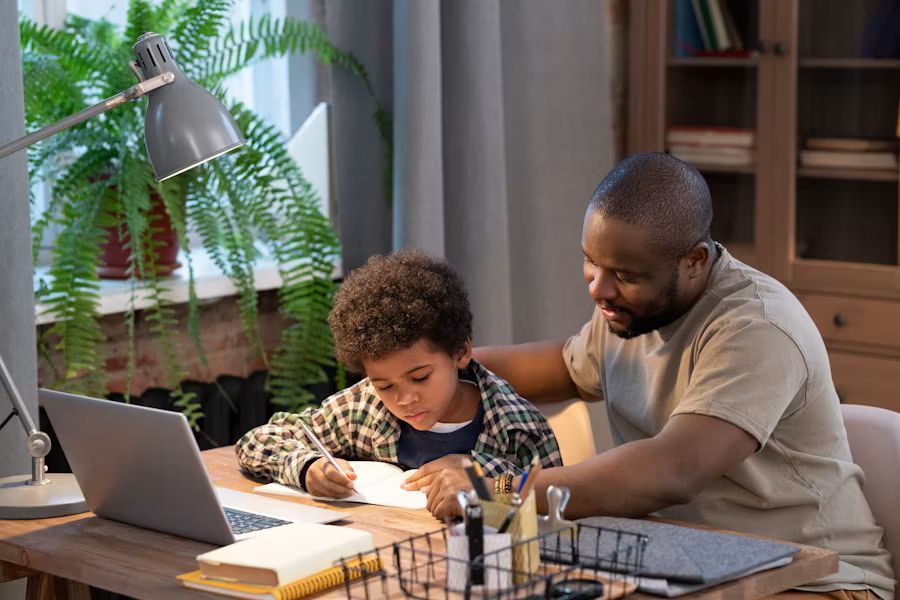
- Create a consistent, dedicated learning space. An environment that signals focus and purpose reinforces the message that learning matters and that your child is capable of it
- Give age-appropriate autonomy over the learning schedule. When children have ownership over when they tackle certain tasks, engagement and confidence both increase
- Keep communication open and shame-free. Children who can express frustration without fear of judgement are far more resilient when learning becomes difficult
- Model your own relationship with challenge. Children absorb parental attitudes toward difficulty and setbacks; showing them that you persevere and that it is acceptable not to know something yet is one of the most powerful confidence tools available
What About Social Confidence?
Why online school is good for shy or quiet children socially is not always immediately obvious and it is worth addressing the concern directly rather than brushing past it.
Socialisation in online schooling is different from traditional school but not absent. Children build genuine connections through extracurricular activities, sports, community groups and collaborative online learning. For many children who have struggled with the forced social dynamics of a traditional classroom, social confidence actually improves once that pressure is removed. The connections formed outside a conventional school setting tend to be more voluntary, more intentional and in many cases, more meaningful.
How Evolve Online School Supports Learner Confidence
The
advantages of Evolve Online School extend well beyond academic results. Evolve's structured yet flexible curriculum, qualified educators, and personalised learning pathways are designed with the whole child in mind and not just their grades. Learner progress and wellbeing are monitored on an ongoing basis, and the learning experience is shaped to meet each child where they are, not where the class is.
For children who arrive having lost confidence in themselves as learners, that matters. Online schooling at Evolve is not simply a delivery mechanism for content. It is an environment designed to help children discover who they actually are as learners, often for the first time.
FAQs
- How do I know if my child's confidence issues are better addressed by online school or in-person therapy?
The two are not mutually exclusive. If your child's challenges are rooted in the school environment itself, like social pressure, bullying or an ill-fitting pace of learning, a change of environment can produce significant improvement. If the anxiety is more pervasive, affecting life well beyond school, professional support is worth pursuing alongside any change in schooling. - Can a naturally shy child develop genuine social skills through online schooling?
Yes — and for many shy children, online schooling accelerates that development. When the overwhelming social demands of a traditional classroom are removed, shy children often engage more readily on their own terms. Social confidence tends to grow most naturally when children feel safe, and online schooling provides exactly that for many learners. - How long does it typically take for a child to settle and build confidence in an online school environment?
Most children find their rhythm within the first few weeks, though children coming from a difficult school experience may need a full term before genuine confidence begins to emerge. Watch for the quieter signs: less resistance to sitting down to work, more questions asked, less shame attached to learning. Those shifts, however gradual, are meaningful. - What role do Evolve's educators play in supporting the emotional wellbeing of enrolled learners?
Evolve's educators monitor individual learner progress and wellbeing on an ongoing basis, and feedback is personalised and constructive rather than comparative. The teacher-learner relationship in an online setting tends to be more direct than in a large classroom. Parents are encouraged to keep communication open with the teaching team so that concerns can be addressed early. - How can I track whether my child's self-esteem is genuinely improving during online schooling?
Watch for behavioural and emotional indicators rather than academic metrics alone. Is your child attempting tasks they previously avoided? Recovering more quickly from mistakes? Speaking about their learning with less frustration? These are the signs of genuine self-esteem growth. It’s a shifting relationship with learning itself, not just improved performance.