Your First 30 Days of Homeschooling: A Parent's Survival Guide
Key Takeaways
- The first month is about adjustment, not academic achievement. Give yourself and your child permission to find your footing before expecting polished results.
- Deschooling is a valuable and necessary phase. Allowing your child to decompress from traditional school is an investment and not a delay.
- A consistent routine matters more than a packed schedule. Predictable anchors in the day create safety and focus far more effectively than rigid timetables.
- The learning environment and parental wellbeing both directly affect outcomes. An intentional space and a calm parent are your two most powerful teaching tools.
- Common early mistakes are easily avoided once named. Knowing the pitfalls in advance means you can sidestep most of them entirely.
- Signs of progress in month one are often subtle, trust them. Curiosity, reduced anxiety and a sustainable rhythm are genuine milestones worth celebrating.
- You don’t need to have all the answers. You need to stay curious, stay flexible and trust that this process, imperfect as it feels, is working.
You’ve made the choice to homeschool. This is significant decision, and it is completely normal to feel a mix of excitement and uncertainty as your first day at home approaches. That quiet voice asking whether you are really prepared, if you’ve made the right choice, if you know enough. Every homeschooling parent has heard it and you’re not alone in it.
This first month homeschooling guide exists because the first 30 days are both the toughest and the most important. This isn’t a performance test. It is a transition. And if you approach it with the right mindset, week by week, you will come out the other side with something far more valuable than a stack of completed worksheets. You’ll come out with a real understanding of how your child learns, and the confidence to guide that learning from home. Before you dive in, it is worth reading our parent's guide to beginning homeschooling for a grounding overview of what home education actually involves.
What to Expect in Your First Month of Homeschooling
One of the most liberating reframes you can adopt before Week 1 even begins is this: the first 30 days are not about academic achievement. They are about adjusting. Neither you nor your child will have everything figured out straight away, and expecting otherwise is the surest route to feeling like you are failing when you are actually just beginning.
Knowing what to expect in your first month of homeschooling means accepting that some days will feel chaotic. Your child might resist sitting down. You might feel underprepared. The schedule might fall apart by Tuesday. None of this is evidence of failure. It is simply part of the process. The goal of the first month is to establish safety, trust and routine. Academic rigour comes once that foundation is in place.
The Adjustment Period Is Normal
Many children need a period of decompression after leaving traditional school. This is particularly true for those who had a stressful or rigid experience. This is sometimes called deschooling: the time a child needs to shake off the conditioning of formal schooling before they can engage openly with learning at home. The general rule of thumb is one month of deschooling for every year your child spent in formal education.
Pushing curriculum too hard too soon often backfires. It can create resistance that takes weeks to undo. Allowing space in the early days isn’t time wasted. It’s an investment in long-term engagement and trust.
Letting Go of the Traditional School Model
Here is a trap that catches almost every parent that’s new to homeschooling – they unconsciously try to replicate school at home. Timed lessons. Rigid subjects. A full six-hour academic day. That model doesn’t often work in a home environment and can lead to burnout for both parent and child.
Think in terms of learning blocks rather than lesson periods. Measure progress by engagement and understanding, not hours spent at a desk. A focused 25-minute session where your child is genuinely curious is worth more than a reluctant two-hour long slog.
Week by Week: How to Structure Your First 30 Days
Think of the four weeks ahead not as four identical units, but rather as four distinct phases, each with a clear and manageable focus. Knowing how to structure the first week of homeschooling looks quite different from Week 4, and that is entirely intentional.
Week 1 — Settle, Observe, and Deschool
Your priority in Week 1 is not academic output. It is observation and relationship. Homeschool first week advice from experienced parents is remarkably consistent: slow down.
Spend this week noticing how your child learns naturally. When are they most alert. Is it in the morning or afternoon? What captures their attention without any prompting? How do they respond to gentle structure versus open-ended time? Keep formal learning light. Read to them. Explore topics they love. Let curiosity lead. This week sets the emotional tone for everything that follows.
- Observe without judging – note what sparks genuine interest
- Keep the day relaxed and low-pressure
- Have one short, enjoyable learning activity per day: a puzzle, a read-aloud, a nature walk
- Introduce the learning space gently, not as a classroom but as a comfortable home base
Week 2 — Establish a Daily Routine
Begin introducing a gentle, consistent daily rhythm. The aim isn’t to achieve a rigid timetable, but rather predictable anchors in the day. A start time, a mid-morning break, lunch and an end point. Consistency reduces anxiety for both parent and child and creates the conditions in which learning can happen comfortably and happily. Understanding
why learning routines matter in homeschooling will help you design a rhythm that genuinely supports your child's wellbeing and not just their timetable.
- Introduce one or two core subjects in short, focused blocks of 20–30 minutes each
- Build in movement breaks. These aren’t optional extras
- Avoid overloading the schedule; less is genuinely more at this stage
- Start and end each day with a simple ritual that signals transition
Week 3 — Introduce the Curriculum Properly
By Week 3, most children are ready to engage more consistently with structured learning. Begin working through the curriculum in earnest but maintain flexibility. If a topic sparks genuine interest, go deeper. If a method is not working, adapt it without feeling guilty.
This week is also when parents often begin to find their footing as facilitators rather than teachers. You don’t need to design lessons from scratch or have an expert answer for every question. Lean into the resources and support provided by your online school provider. This exists to help you through this transition.
- Work through each curriculum subject in structured sessions
- Track what engages your child and what creates resistance
- Ask your child for feedback. They often know what is working better than we assume
- Adjust pacing based on what you observe, not what you originally planned
Week 4 — Review, Reflect, and Adjust
Use the final week of the first month as a deliberate reflection point. This is one of the most undervalued steps in the early homeschooling journey. It directly addresses the question of how long does it take to adjust to homeschooling. The answer to this depends on what you learn in these early weeks and how honestly you respond to it.
Ask yourself:
- What has worked well?
- Where has your child engaged most genuinely?
- What has felt forced or ineffective?
Adjust your routine, pacing or approach based on what you have actually observed and not what you think it should look like. Celebrate the wins, even if they’re small. Going into month two with a clear picture of what works for your specific child is worth more than any perfectly planned curriculum.
Setting Up Your Home Learning Environment
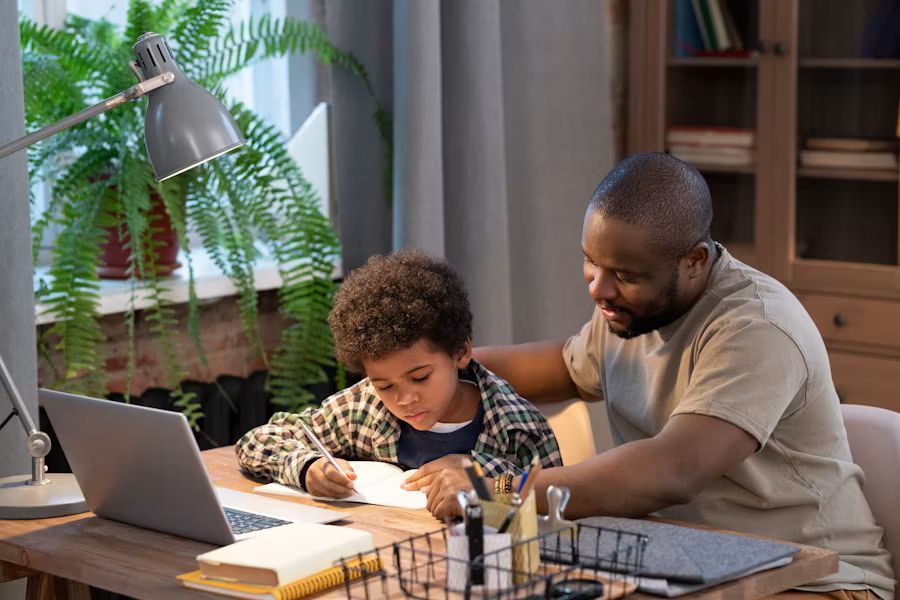
Understanding what does a typical homeschool day look like for beginners includes recognising that the physical environment matters more than most parents anticipate. A dedicated, consistent learning space, even a corner of a room, signals to your child that it is time to focus. It also signals to the rest of the household that interruptions should be minimised.
Your learning space doesn’t need to be elaborate. It needs to be intentional.
- Remove distractions: toys, screens and competing stimuli should be out of sight during learning time
- Ensure good lighting: natural light is ideal; poor lighting creates fatigue quickly
- Keep supplies accessible: pencils, paper and reference materials within easy reach reduce disruption mid-session
- Separate learning from relaxation: wherever possible, avoid using the couch or bed as the primary learning space
- Make it theirs: let your child contribute to setting up the space because ownership increases engagement
Managing Your Own Wellbeing as a Homeschooling Parent
Homeschooling is demanding for parents, particularly in the first month. The combination of new responsibilities, self-doubt and the constant proximity to your child's learning can be genuinely exhausting. Acknowledging that isn’t a weakness. It’s an accurate reading of the situation.
The most effective thing you can do for your child's homeschooling experience is take care of yourself. A calm, patient facilitator is more valuable than a perfectly structured lesson plan.
- Plan time away from the teaching role daily, even if it is just 20 minutes
- Connect with other homeschooling families for community, perspective and reassurance
- Resist the urge to over-plan or over-teach; perfectionism is your biggest enemy in month one
- Protect your energy across the week by reviewing these time management tips for homeschooling parents
- Remember: you are your child's guide, not their entertainer, therapist, and subject expert simultaneously. That is a far more manageable role.
Common Mistakes New Homeschooling Parents Make
These tips for parents new to homeschooling are most often learned the hard way. Knowing them in advance is a genuine advantage.
- Trying to replicate a full school day at home. Six hours of structured lessons is neither necessary nor effective. Two to four hours of focused learning is typically sufficient.
- Skipping the deschooling period. Jumping straight into heavy curriculum before your child has decompressed often creates resistance that takes far longer to resolve than the deschooling itself would have.
- Comparing your child's progress to traditionally schooled peers. Homeschooling operates on a different rhythm. Comparison to classroom benchmarks is rarely helpful and frequently demoralising.
- Neglecting your own mental health and boundaries. See the section above. This isn’t optional.
- Choosing a curriculum before observing how your child actually learns. The best curriculum is one that suits your specific child and not the most popular one on a forum.
- Setting unrealistic expectations for Week 1. If everyone ends the first week feeling safe, curious and reasonably calm, Week 1 was a success.
- Failing to build in flexibility. Some days will simply not go to plan. That is recoverable if you allow it to be.
Signs That Things Are Going Well
Progress in the first month of homeschooling rarely looks dramatic. It is quiet, cumulative and easy to overlook if you are focused on what isn’t yet working. Here are the signs that starting homeschooling for the first time is going in the right direction, even when it doesn’t feel perfect:
- Your child is asking questions and showing genuine curiosity
- They are less anxious about learning than they were in traditional school
- You are finding a rhythm, however imperfect, that both of you can sustain
- Your child is engaging with at least some subjects with real interest
- Both of you are ending the day without dread about tomorrow
- You are learning things about how your child thinks that you never knew before
These quieter signs are meaningful. Trust them and trust the process. Month two will build on everything that month one has taught you.
FAQs
- How long does the deschooling period typically last, and how do I know when my child is ready to begin formal learning?
A useful starting point is one month of deschooling for every year your child spent in traditional school. In practice, readiness looks like genuine curiosity returning, reduced resistance to learning activities and a willingness to engage without anxiety. Watch for the shift in your child's mood and openness rather than counting calendar days. - How many hours a day should we spend on formal learning in the first month of homeschooling?
For primary school age children, two to three hours of focused learning per day is typically sufficient. For secondary school age students, three to four hours of structured work is realistic. The key word is focused and quality of engagement matters far more than hours logged. - What does a typical homeschool day look like for a beginner family in the first few weeks?
A gentle structure might look like this: a calm start with a brief check-in. One or two short learning blocks of 20–30 minutes each in the morning. A generous lunch break with outdoor time. One creative or practical activity in the afternoon. A relaxed close to the day with reading or a shared interest. Flexibility within this rhythm isn’t a failure, it is a feature. - How do I stay motivated and avoid burnout as a homeschooling parent during the early adjustment period?
Remind yourself of the reason you chose homeschooling. This is a powerful source of motivation on difficult days. Build community with other homeschooling families. Set clear working hours so you have genuine time off from the teaching role. Be honest with yourself; some days are hard. That honesty, rather than forced positivity, is what sustains parents long-term. - What curriculum or resources should I start with if I am completely new to homeschooling?
If you are working with an established online homeschool provider, lean into their curriculum and support systems rather than trying to supplement from scratch in month one. A single, well-structured curriculum used consistently will serve your child better than a patchwork of resources. Once you have observed how your child learns, you will be far better placed to make informed choices. For a broader overview, our parent's guide to beginning homeschooling is a strong place to start.